
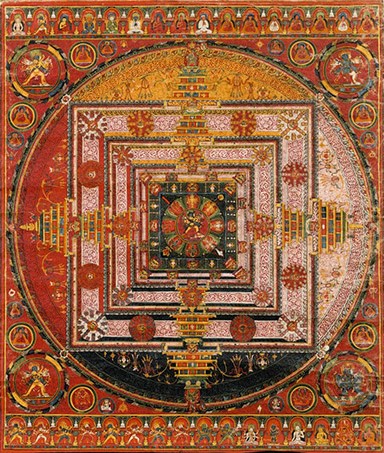
For my money, one of the most beautiful art forms in the world is the mandala, commonly created by Buddhit monks using colored sand. While I find the colors and patterns fascinating, their defining characteristic lies in their eventual and purposeful destruction. The sands are swept off their base, revealing and restoring the blank slate upon which the mandala was created.
The destruction reminds the mandala creators and viewers that everything in life – good, bad, beautiful, tragic, happy, sad – is temporary. We must not be afraid to let go of good things when the time comes, and we must be able to move on from bad things and recorgnize that the pain or sorrow will not remain forever.
We can learn much from mandalas and the ephemerality granted to them by their creators. Societally, we seem too obsessed with holding onto the past on the off chance we might need something from it. We have tens of thousands of images and videos on pur phones, most of which we will never view again, backed up to cloud storage accounts with tens of thousands more. We hold onto material possessions with no monetary or sentimental value. I have frying pans burnt to shit, kitchen appliances I never use, and food and drinks I do not consume sitting in my kitchen. Something stops me from discarding them, some aversion to waiving any remaining value or additional use. But when we finally throw out the old t-shirt or delete the shaky concert video, we wonder why we held on to it for so long in the first place.
Experiences get a bit more complicated, as they cannot necessarily be destroyed or wiped from our memories, but I don’t think they should be. We should always strive to remember our good experiences and learn from our bad experiences. The beauty of a mandala remains long after the sands are swept away. The destruction is merely to the physical manifestation of that beauty. Our raw emotions, the immediate highs and lows we feel during and after any experience, are the physical manifestations. The mandala teaches us to see and feel these raw emotions, take a brief moment to absorb them, and ultimately wash them away, leaving a mental imprint of life devoid of visceral emotional interference.
Maybe you disagree, but we all know someone who constantly brings up a minor spat from ten years ago or the guy pushing 50 with a beer gut who still wears his high school class ring with his football number prominently embossed. We can let the gravity of life remain without the endless physical reminders. Try moving to a new house or a new state, and you’ll quickly realize how much useless shit you have. I’m not saying to destroy all your creations or possessions, but I think we need to reassess what constitutes a meaningful possession. Over the course of a few months several years ago, I compiled over 70,000 words of thoughts, reactions, rants, and ramblings. Most was garbage, but it was a meaningful endeavor. When I deleted all of it a few years later, I felt relief more than anything else. Destruction frees up room in the mind and on the page for more creation. If you want to take the mandala mindset to the extreme, go for it. Maybe you’ve spent decades cultivating meaningful relationships with loved ones and are now inspired to abandon them. Maybe you’ve spent decades raising your children to be productive members of society and are now inspired to kill them. Under advice of councel, I have to discourage that, so start small. Recognize that emotions are fleeting. Good and bad things come to an end. Learn to separate the physical or digital manifestations of creative endeavors and life experiences and to live without them. When you eventually exit this plane of reality and leave your kids to sort through boxes of all your shit, they will thank you.
For you movie buffs, two movie quotes come to mind. In Pee-Wee’s Big Adventure, when Dottie asks Pee-Wee why he’s leaving the drive-in theater showing the movie about his life, he says, “I don’t have to see it, Dottie. I lived it.” Pee-Wee understands that he only needs his own recollection of his life, and a reproduction of it does not provide any additional value. Second, in Avengers: Age of Ultron, when Ultron claims that humans are doomed, Vision replies, “Yes, but a thing isn’t beautiful because it lasts.” Let’s learn from mandalas, Pee-Wee Herman, and Vision. When creating experiences, literature, or art, let the lasting memory be the act of creation itself rather than a picture in a frame, and video in the cloud, printed words on a page, oil on canvas, or dyed sand on slate.
But Danny, if creative destruction is so beautiful to you, why are you posting your thoughts on the internet for the world to see forever? Wouldn’t it be more meaningful to write it down and erase it?
That’s a great question, but it looks like we’re out of time for today.

 DannyPlops
Leave a comment